

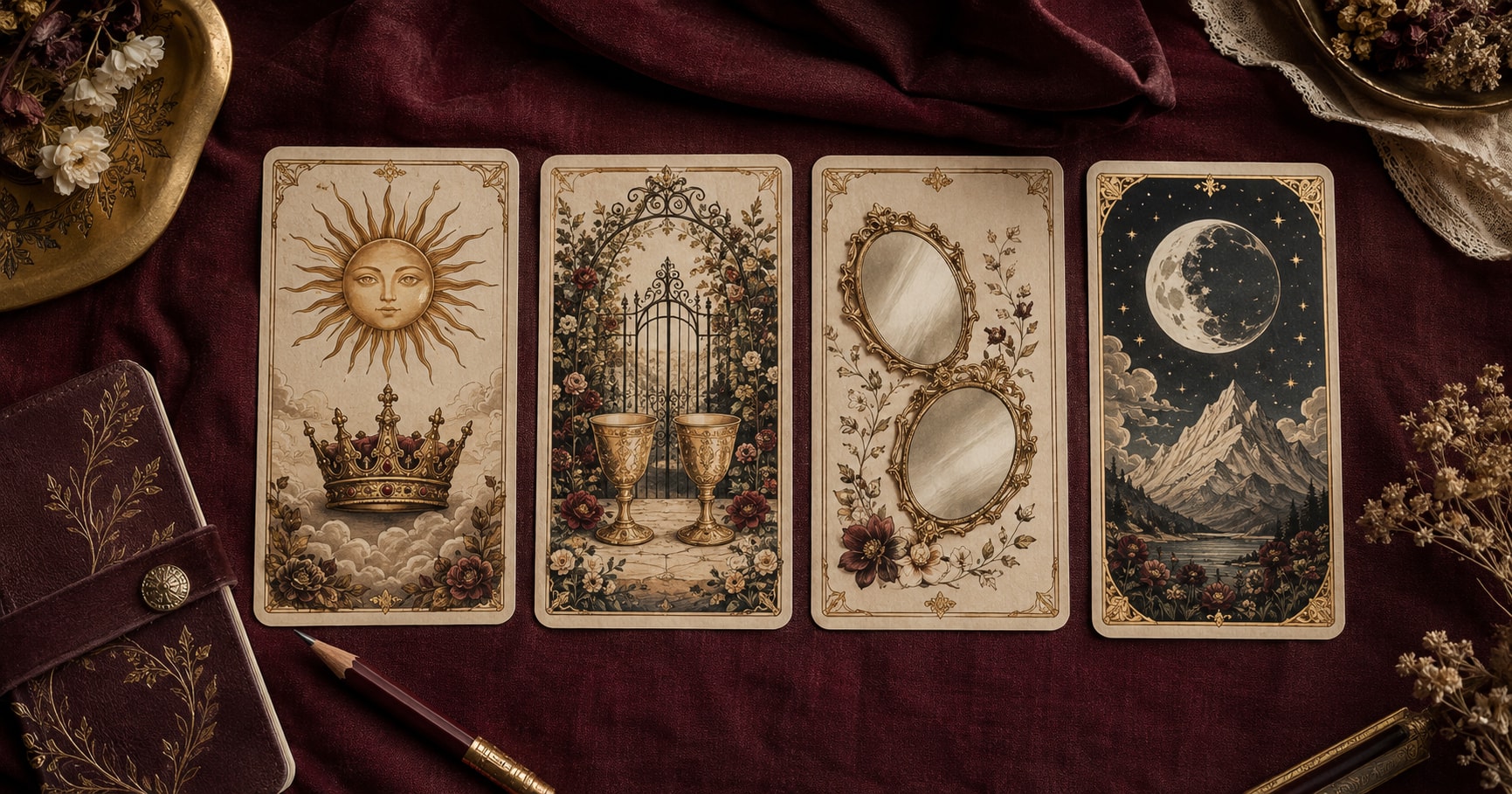
Tarot Archetypes & Relationship Reflection
Tarot can offer symbolic language for thinking about relationships. The cards cannot verify a soulmate, past life, twin flame or predetermined future. These four archetype pairings are better used as prompts: What dynamic does this image remind you of, and what does your real relationship show?
1. The Magician + High Priestess: Action and Intuition
This pairing can symbolize the tension between doing and sensing. In a relationship, one person may prefer decisive action while another processes quietly or intuitively.
Reflection Questions
- Do we make decisions in compatible ways?
- Can intuition be discussed without treating it as proof?
- Does one person dominate while the other stays silent?
- How do we turn shared ideas into real plans?
A theme to explore.
The meaning you associate with it.
What the relationship actually does.
2. The Emperor + Empress: Structure and Nurture
This pair is often read through themes of stability, care, responsibility and creation. It does not prove a past-life connection or destined family. Use it to examine how care and power are distributed.
Reflection Questions
- Do both people have a voice in major decisions?
- Is caregiving shared fairly enough?
- Are traditional roles chosen or assumed?
- Does stability support both people’s growth?
3. The Lovers: Choice, Values and Mirroring
The Lovers can symbolize attraction and relationship choice. Rather than treating the card as confirmation that someone is a twin flame, ask whether the connection reflects your values and whether the relationship is mutually chosen.
Reflection Questions
- What am I choosing—not just feeling?
- Does strong chemistry coexist with respect?
- Am I keeping my own identity?
- Would I accept this behavior without a spiritual label?
4. The Sun + Moon: Clarity and Uncertainty
The Sun and Moon can be used to reflect on what feels clear versus ambiguous in a relationship. They do not prove that opposites are destined to attract or that one partner contains another’s “dark side.”
Reflection Questions
- What do I know from evidence?
- What am I guessing?
- What needs direct conversation?
- Can differences coexist without one person rescuing the other?
Do Tarot Cards Predict How You Will Meet a Soulmate?
A reader may interpret cards around possible settings or themes, but tarot does not reliably identify a future person, date or location. Use practical dating opportunities if meeting someone is your goal.
Can Tarot Confirm a Past-Life Relationship?
No. Past-life interpretations are spiritual beliefs. A card spread is not historical evidence.
Can Tarot Confirm a Twin Flame?
No independent method can verify a twin-flame label. If the relationship is intense, evaluate consent, safety, compatibility and mutual choice.
A Simple Three-Card Relationship Reflection
- What am I bringing? Reflect on your needs and patterns.
- What is happening between us? Focus on current behavior.
- What deserves attention? Choose one conversation or action.
When Tarot Becomes Less Helpful
Step back if you are repeatedly pulling cards until you get the answer you want, using tarot to override another person’s “no,” or making high-stakes medical, legal, financial or safety decisions from a spread.
The Card Can Start a Question—It Should Not End the Conversation
Tarot is most useful here as a mirror for your own reflection, while the relationship itself is evaluated through real choices and behavior.
Related Guides
- What a Tarot Reading Can Teach About Love
- Soulmate, Karmic or Twin Flame Labels
- Meeting a Soulmate Without Waiting for Destiny
- Love Astrology, Tarot & Numerology
Frequently Asked Questions
1. Can tarot tell me how I will meet my soulmate?
No reliable method can guarantee a future person, place or date.
2. Can tarot prove someone is my soulmate?
No.
3. Can tarot prove a past life?
No.
4. Can The Lovers card confirm a twin flame?
No.
5. What does the Magician symbolize here?
It can be used as a prompt around action, agency and intention.
6. What does the High Priestess symbolize?
It can prompt reflection on intuition, privacy and inner processing.
7. What can the Emperor and Empress represent?
They can prompt questions about structure, care, power and responsibility.
8. What can the Sun and Moon represent?
They can be used to explore clarity, uncertainty and contrast.
9. Are tarot meanings fixed?
No, meanings vary by deck, tradition and reader.
10. Should I keep pulling cards until I get a positive answer?
No. That can turn reflection into reassurance seeking.
11. Can tarot reveal another person’s private thoughts?
No private-thought claim can be independently verified.
12. Should tarot decide whether I stay in a relationship?
No. Use behavior, safety, compatibility and your own judgment.
13. Can tarot replace direct communication?
No.
14. What is a grounded tarot question?
Ask what you may need to notice about your own choices or patterns.
15. What is the healthiest use of relationship tarot?
Use cards to generate reflection questions rather than prove destiny.

Wow, using Tarot to explain love and relationships! What’s next, crystal ball readings for your career path? It’s amusing but also adds a whimsical charm to the otherwise daunting task of finding love.
This article is a beautifully articulated exploration of the multifaceted nature of love and soulmate connections. The depth of insight presented, especially through the archetypes of the Tarot, offers a profound understanding of how different soulmate dynamics can enrich our lives. I was particularly moved by the concept of ‘The Magnetism’ and how it unveils the contrasting yet complementary forces that can lead to an unconditional and liberating love. Truly, love is a journey of self-awareness and spiritual fulfillment.
The exploration of soulmate archetypes is fascinating. It provides a framework for understanding the different dynamics that one might experience in relationships. The idea that these relationships can act as catalysts for personal growth and spiritual fulfillment is quite profound.
I appreciate the detailed descriptions of the various types of soulmate connections. The use of Tarot archetypes adds an intriguing mythological layer to the concept, making it easier to grasp the nuances of each relationship type. This article offers a unique perspective on love and connection.
An enlightening read! The detailed descriptions of the four types of soulmate connections resonate deeply and provide valuable guidance for anyone navigating the complexities of human relationships. The archetypal analysis using the Tarot offers a refreshing perspective that bridges ancient wisdom with modern experiences of love. I found ‘The Past Life Connection’ particularly compelling, as it highlights the timeless bond that transcends lifetimes. This piece is a reminder of how vital human connection is for our emotional and spiritual well-being.
The connections you draw between different types of soulmates and their spiritual roles is fascinating. This perspective could benefit those exploring their own relationships through a spiritual lens. However, it’s important to remember that not all readers may find value in ancient Tarot teachings.
It’s fascinating how the archetypes from ancient Tarot can provide such profound insights into modern relationships. The way you’ve described the different types of soulmate connections is both enlightening and thought-provoking. Thank you for this profound wisdom.
Honestly, this is quite a stretch. Using Tarot to define soulmates seems more like a fantasy than reality. Relationships are complex and subjective; boiling them down to archetypes oversimplifies the nuances of human connection. This feels more like wishful thinking than practical advice.
The emphasis on spiritual growth and self-awareness through relationships is compelling. I found the ‘Mirrored Reflection’ and ‘Magnetism’ archetypes particularly enlightening, as they highlight the potential for both profound connection and personal challenges. This article offers valuable insights into the transformative power of love.
The ‘Power Duo’ and ‘Past Life Connection’ archetypes particularly resonate with me. The idea that these relationships can provide both stability and inspiration is comforting. It’s interesting to think about how different soulmate connections can fulfill various emotional and spiritual needs.
Well, if finding a soulmate is as easy as reading Tarot cards, why are dating apps still in business? Maybe we should just swap our swipes for a deck of cards and wait for the universe to do its magic. Sounds foolproof, doesn’t it?
This is truly enlightening! The way you’ve connected soulmate relationships with the archetypes in Tarot is both profound and deeply poetic. It’s incredibly inspiring to think that each kind of soulmate partnership has its own unique divine purpose. Thank you for this beautiful exploration!
So, we’re supposed to believe that Tarot cards can tell us about our soulmate now? Next thing you know, horoscopes will become a mandatory part of relationship counseling. It’s intriguing yet highly debatable.
I must argue that while the notion of ‘soulmates’ provides comfort, it can also lead people to unrealistic expectations. Life is dynamic, and relationships require continuous effort and compromise. Focusing too much on finding a ‘soulmate’ might deter one from appreciating the complexities of real-world relationships.
I see your point, Margaret. However, I believe the article encourages a deeper exploration of relationships rather than promoting an idealized view of soulmates. It’s about understanding different connection types to foster growth and self-awareness, not just finding a perfect match.
This article provides a comprehensive look at the complexities of soulmate relationships. The distinctions made between the different types help to clarify the roles they play in one’s life journey. It’s a thought-provoking read for anyone interested in the deeper aspects of human connection.
Ah, another article romanticizing the idea of ‘soulmates’. What happens when someone doesn’t fit neatly into one of these categories? Life and love are far more complex than ancient Tarot archetypes.
This article offers a broad range of perspectives on relationships that can be quite useful. The categorization using Tarot archetypes provides a unique framework for understanding the dynamics and potential of different partnerships.