


Healthy Relationship Guide
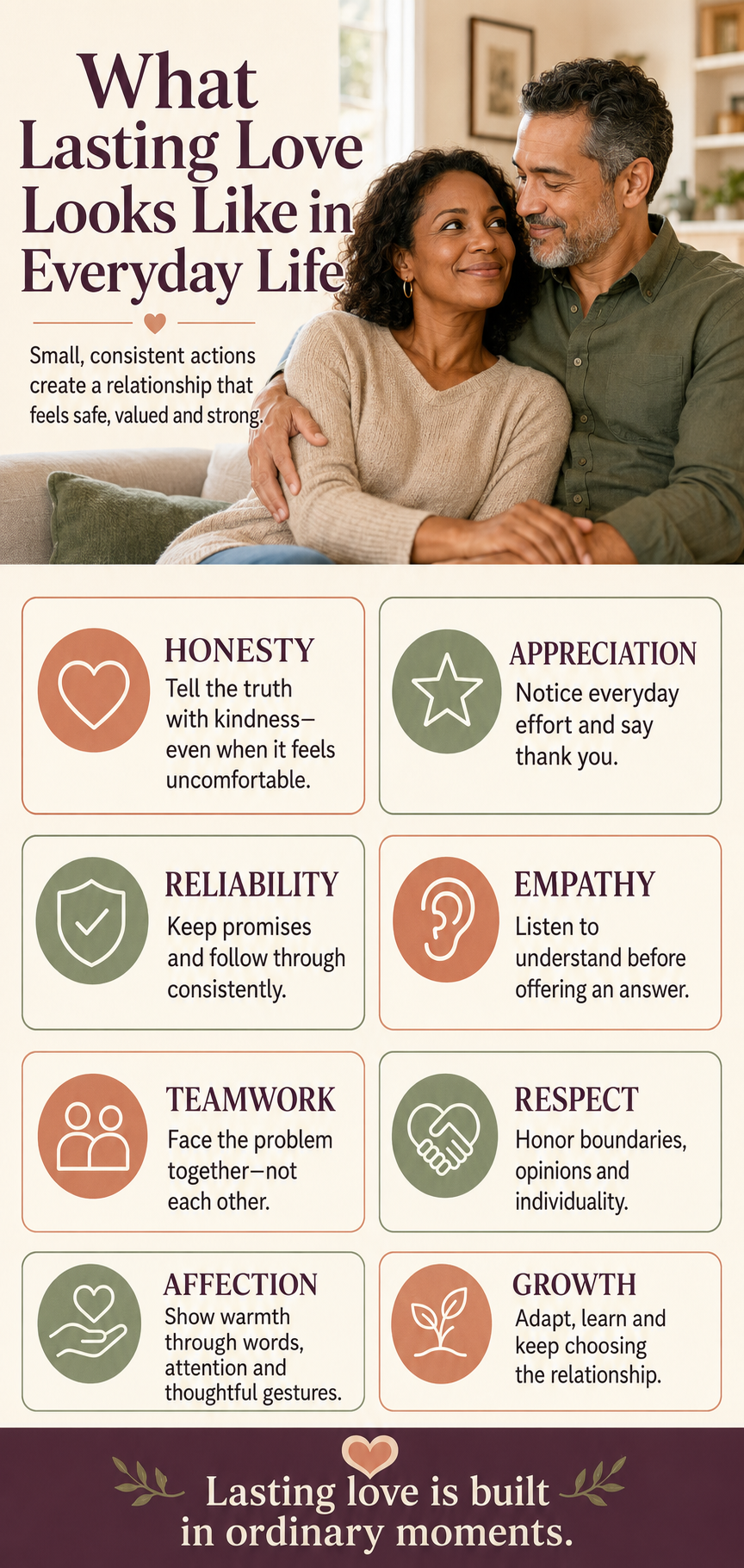
Strong relationships are not defined by never arguing or always feeling close. They are built through repeatable habits: listening, repairing conflict, showing affection, respecting boundaries, sharing responsibility and staying curious about each other as life changes. The 15 qualities below are practical signs of a healthier relationship—not a checklist that every couple has to perform perfectly.
Actions match words over time.
Conflict is addressed, not buried.
Needs and feelings can be expressed.
Both people can remain individuals.
Healthy relationships usually involve a mix of connection and independence. Couples can disagree, need space, have different temperaments and still build a stable partnership when they handle those differences with respect. If you are working on communication specifically, see our guide to understanding an “I’m fine” response without jumping to conclusions.
1. You Try to Solve Problems, Not Win Arguments
Conflict becomes more useful when the goal is understanding rather than victory. Healthier couples are more likely to slow the conversation down, listen for the underlying concern and look for a solution both people can live with. Helpful repair language can be simple: “Help me understand,” “I handled that badly,” or “What would make this feel fairer to both of us?”
2. Attraction and Affection Are Still Expressed
Long-term love can become familiar, but familiarity does not have to mean emotional neglect. Affection may include touch, compliments, flirting, thoughtful gestures, eye contact or simply making a partner feel noticed. The right amount and type of affection differs by couple, so consent and preference matter more than following a formula.
3. Communication Is Honest Without Becoming Cruel
Healthy communication is not constant talking. It includes timing, clarity, listening, emotional regulation and the ability to say what is actually happening underneath a complaint. “I felt disconnected today and wanted reassurance” is usually more actionable than “You never care.” The American Psychological Association also emphasizes communication, respect and problem-solving as parts of healthier relationships: APA healthy relationships guidance.
4. You Function as a Team
Fairness does not always mean splitting every task 50/50. It means noticing workload, emotional labor and changing circumstances so one person does not become chronically overburdened. Strong teamwork is flexible: one partner may carry more during a difficult week, but the relationship should not depend on one person permanently doing all the practical or emotional work.
5. Both People Keep a Sense of Self
A strong relationship should leave room for sleep, friendships, hobbies, work, quiet time and personal goals. Self-care is not a rejection of the relationship. It can make it easier to return to the partnership with more patience and emotional availability. If you find yourself constantly reshaping your identity to keep a connection, read How to Feel Loved Without Changing Who You Are.
6. Vulnerabilities Are Treated Carefully
Emotional safety means a partner does not weaponize private fears, past pain or insecurities during conflict. It also means being able to say no, ask for time, express discomfort and set reasonable boundaries without humiliation or retaliation.
7. You Make Time to Reconnect
Work, phones, parenting, social media and exhaustion can gradually crowd out connection. Small rituals can help: a walk, a device-free meal, a bedtime check-in, a weekly date or simply ten focused minutes together. The specific ritual matters less than the repeated message: “This relationship still deserves attention.”
8. Conflict Is Followed by Repair
An argument does not automatically damage a relationship. The bigger risk is unresolved hostility, contempt or emotional distance that never gets addressed. Repair can include an apology, clarification, a changed behavior or returning to the topic after both people are calmer.
9. You Stay Curious About Each Other
People change over time. Long-term intimacy benefits when partners keep asking questions instead of assuming they already know everything about each other. Curiosity can be as simple as asking what has been stressful lately, what feels exciting, or what kind of support would help this week.
10. Appreciation Is Expressed
People often notice what is missing more quickly than what is going well. Regular appreciation helps counter that bias. Specific gratitude—“I noticed you handled that difficult call for us”—usually lands more strongly than vague praise because it shows attention.
11. Trust Is Built Through Consistency
Trust is less about dramatic promises and more about repeat behavior: keeping commitments, respecting agreed boundaries, telling the truth, following through and taking responsibility when something goes wrong. Trust can be rebuilt after some ruptures, but rebuilding requires changed behavior—not only reassurance.
12. Individual Growth Is Supported
Partners do not need identical goals or interests. A healthier relationship allows each person to keep developing while also making decisions that affect the partnership together. Support should not mean control disguised as concern.
13. There Is Room for Play and Humor
Laughter can soften stress and help couples reconnect, provided the humor is shared rather than mocking. Inside jokes, playful moments and enjoyable activities remind partners that the relationship is not only a place where problems are managed.
14. Emotional Availability Matters More Than Perfection
A partner does not have to communicate perfectly to be emotionally available. More useful signs are willingness to listen, ability to acknowledge feelings, capacity to return after conflict and genuine effort to understand each other. Persistent avoidance, contempt or punishment for expressing needs is different from simply needing time to process.
15. Major Values Are Compatible Enough to Build a Life Together
Couples can have different personalities and still thrive, but major value conflicts around money, parenting, commitment, lifestyle, family or long-term plans can create recurring strain. Compatibility does not require identical views; it does require a workable way to make important decisions together.
A Healthy Relationship Is Not the Same as a Perfect One
Look for patterns, not flawless behavior. One bad conversation does not define a relationship, and one romantic gesture does not prove that everything is healthy. The clearest picture comes from what happens repeatedly: respect, repair, honesty, boundaries, affection and shared effort. Harvard Health also discusses the role of supportive relationships in well-being: Fostering healthy relationships.
Related Relationship Guides
- When “I’m Fine” Creates Confusion in a Relationship
- Can a Sexless Marriage Be Saved?
- How to Feel Loved Without Changing Who You Are
- Communication & Relationship Skills
- Browse the Complete Article Index
Frequently Asked Questions
1. What makes a relationship strong and lasting?
Strong relationships usually combine trust, respect, communication, emotional safety, affection, shared effort and the ability to repair conflict.
2. Do healthy couples still argue?
Yes. Disagreement is normal. What matters is whether conflict includes respect, listening and eventual repair instead of contempt, threats or repeated punishment.
3. Is communication the most important relationship quality?
Communication matters, but it works best alongside trust, boundaries, empathy and follow-through. Good words without dependable behavior are not enough.
4. How can couples rebuild emotional closeness?
Start with small, repeatable habits such as focused conversations, appreciation, shared time, affectionate touch when welcome and addressing unresolved resentment.
5. What does emotional safety look like?
It means being able to express needs, concerns and boundaries without humiliation, intimidation or having vulnerabilities used against you.
6. Can a relationship be healthy if partners need different amounts of space?
Yes. Different needs for closeness and alone time can work when both people communicate clearly and neither uses distance or attention as punishment.
7. How important is trust in a long-term relationship?
Trust is central because it affects vulnerability, communication and security. It is usually built through consistent behavior over time.
8. Should partners share all the same interests?
No. Separate interests can support individuality. Shared values and the ability to make important decisions together generally matter more.
9. What is a repair attempt after an argument?
A repair attempt is an effort to reduce tension and reconnect, such as apologizing, clarifying, asking to restart the conversation or changing a hurtful behavior.
10. Can affection fade in a healthy relationship?
Affection can fluctuate with stress, health and life changes. The important question is whether both partners can discuss what they need without pressure.
11. How can couples avoid taking each other for granted?
Notice specific efforts, express appreciation, protect time together and keep asking about each other’s changing experiences instead of relying on assumptions.
12. Does a healthy relationship require complete independence?
No. Healthy interdependence allows partners to rely on each other while still maintaining personal agency, relationships and interests.
13. What are signs that teamwork is unbalanced?
Chronic resentment, one person carrying most responsibilities, repeated broken agreements or one partner feeling consistently invisible can signal an imbalance.
14. Can shared values matter more than chemistry?
Chemistry can start a connection, but long-term decisions often depend more on compatible values, reliability and how well partners manage differences.
15. When should couples seek professional help?
Professional support may help when conflict keeps repeating without resolution, communication has broken down, trust has been seriously damaged or either person feels unsafe.